
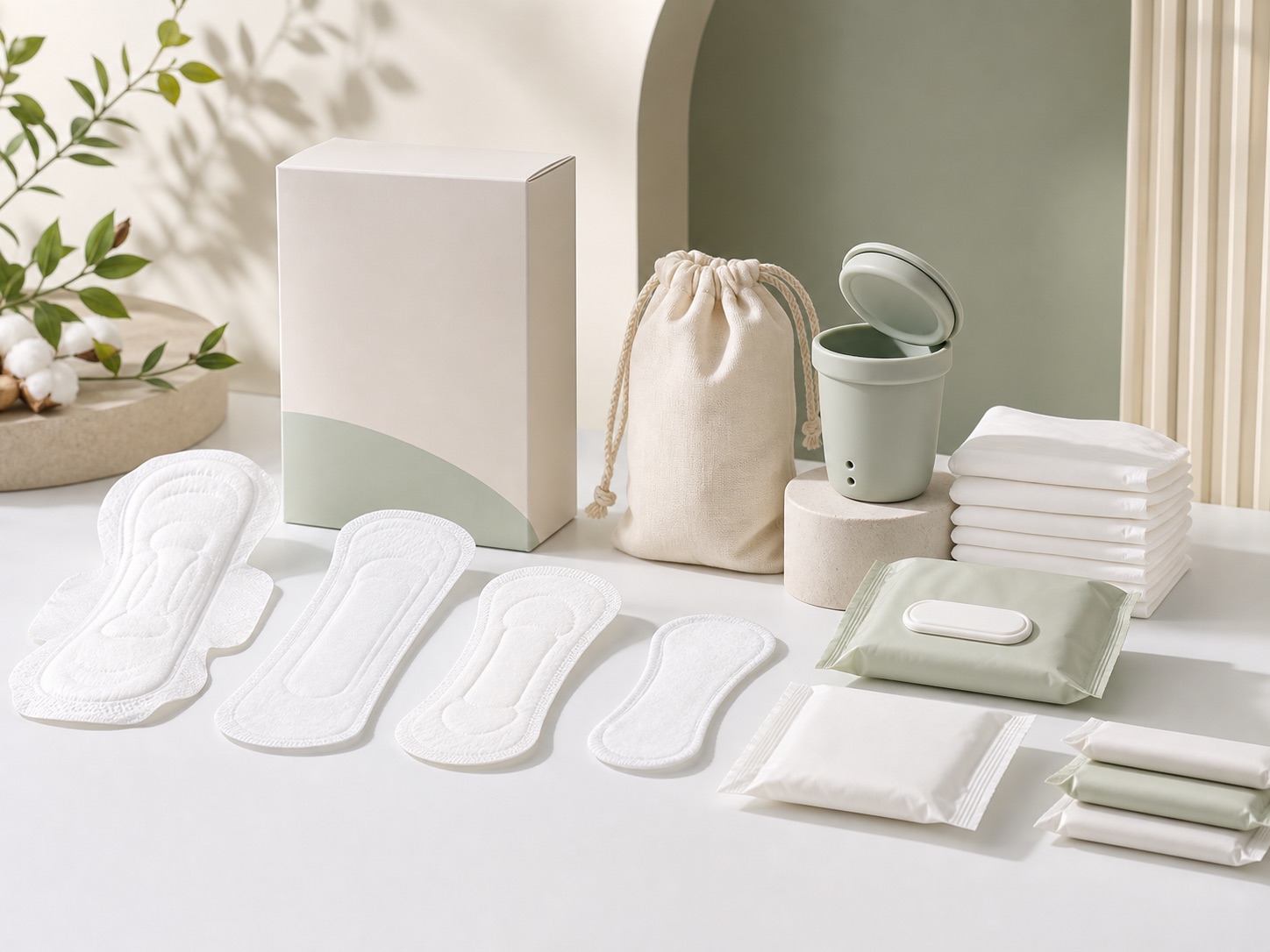
For sanitary pad programs, a useful quote depends on product format, absorbency target, top sheet direction, wrapper, retail count, carton data, documents, and first-order planning. A low price without those inputs is difficult to compare and risky to launch.
Buyer Summary
- Define format, absorbency, top sheet, wrapper, retail count, and carton data before requesting a quote.
- Confirm a written per-SKU MOQ after those inputs are defined.
- Compare suppliers by how clearly they translate your retail plan into a bill of materials and packaging route.
- Treat industry MOQs, lead times, and certificate requests as benchmarks to verify per project, not assumptions.
- Final market approval, registration, and label claims remain the buyer’s responsibility.
Define the shelf product before asking for a price
Sanitary pads look simple from the outside, but private-label buyers compare many variables: length, absorbency, top sheet, back sheet, wrapper, box count, carton size, price tier, and claim wording. A quote without these details is usually too vague for launch planning.
For a sourcing team, the practical first step is to describe the shelf product as if it already exists. What does the shopper see? Is it a liner, a day pad, a night pad, or a mixed assortment? Is the retail pack a carton box, a pouch, or a flow-wrap with a label? Is the product positioned as value-tier, mainstream, natural, organic-cotton direction, bamboo-charcoal direction, or clinical-clean? Each decision changes the bill of materials, packaging cost, MOQ, and document set.
A supplier cannot quote accurately from a product name alone. “Private-label sanitary pads” is not a specification. “Day pad, regular absorbency, soft nonwoven top sheet, individually wrapped, retail carton, English artwork, Amazon launch” is closer to a specification. The clearer the retail plan, the more useful the quote.
Scope note
This page is for conventional white-label and private-label sanitary pads and liners. It does not describe smart pads, sensor pads, app-connected products, or IoT hardware. If your RFQ needs electronics or sensor components, say so explicitly; that is outside this guide and YUJI’s published pad OEM scope.
Format
Define liner, day pad, night pad, or mixed assortment before comparing suppliers. Format is not only length. It also affects absorbency direction, core design, back sheet, wrapper, retail count, and carton planning.
A liner is usually positioned for light daily protection. A day pad is the core regular-flow SKU. A night pad often needs a longer body, wider back, and higher absorbency direction. A mixed assortment can be attractive for trial kits, subscription boxes, distributor catalog expansion, and gift or education bundles, but it multiplies the number of SKUs that must be sampled, approved, packed, and documented.
Pad-program decision table
| Program format | Primary use case | Key specs to define | Common buyer notes |
|---|---|---|---|
| Liner | Daily light protection | Length, top sheet, absorbency direction, wrapper, retail count | Often paired with day pads or cup/disc education packs |
| Day pad | Regular flow | Length, absorbency target, top sheet, back sheet, adhesive, wrapper, count | Usually the core volume SKU |
| Night pad | Overnight or heavier flow | Longer length, higher absorbency direction, wider back, wrapper, count | May need different carton and pack economics |
| Mixed assortment | Trial, kit, subscription, distributor catalog | SKU mix, counts per pack, carton plan, barcode, language | More complex MOQ per SKU and artwork control |
Materials
Top sheet, absorbent core, back sheet, wrapper, and claims direction should be clear. Material direction affects feel, leakage positioning, cost, and what you can safely say on the label.
Top sheet options may include soft nonwoven, perforated film, organic-cotton direction, bamboo-charcoal direction, or value-focused structures. The absorbent core may use fluff pulp, SAP, or a blend depending on absorbency target and price tier. The back sheet may be breathable or standard, and the adhesive pattern affects fit and comfort. The wrapper may be plain, printed, recyclable direction, or hygienic flow-wrap.
Claims deserve special attention. “Organic,” “hypoallergenic,” “chemical-free,” “biodegradable,” and similar wording must be substantiated for the target market. The buyer should confirm final claim language with its regulatory and legal advisors. YUJI can help translate approved claims into packaging production, but final market approval and label claims are the buyer’s responsibility.
Industry-typical certifications and test files buyers often ask about include ISO 13485, ISO 9001, ISO 10993 biocompatibility, CE technical-file support, FDA establishment registration, SGS per-lot test reports, and REACH/RoHS. These are industry-typical requests, not claims about YUJI. YUJI’s document availability must be confirmed per project.
Pack
Retail count, box, pouch, barcode, carton, and language affect cost and lead time. Packaging is often where a pad quote changes most after the first sample.
Define the retail pack count, pack style, artwork dimensions, barcode requirements, and language before asking for a final price. Carton data matters just as much: pack count per carton, carton dimensions, gross and net weight, carton marks, pallet pattern, and warehouse or Amazon FBA requirements. If the carton is wrong, freight and warehouse costs can change after production.
| Per-market packaging and claims checklist | Packaging/label checklist | Document and claim note |
|---|---|---|
| US retail / Amazon | English label, importer text, warnings, retail barcode, claims review | Buyer confirms local regulatory route and labeling |
| EU | CE route, local language(s), importer, warnings | Buyer owns CE technical file and final claims |
| UK | UKCA route, language, importer, warnings | Buyer confirms local registration and label wording |
| Canada | English/French, importer, warnings | Buyer confirms local route and claim substantiation |
| Australia / New Zealand | English, warnings, retail barcode | Buyer confirms local regulatory and labeling route |
| Middle East | Arabic/English, importer, shelf pack | Buyer confirms registration and import documents |
| Distributor / pharmacy | Professional pack, carton marks, tender docs | Documents may be required per tender or customer |
| DTC / subscription | Mailer fit, wrapper, brand story | Claims must be substantiated before listing |
MOQ
Confirm a written per-SKU quantity after pack design, material, and project scope are defined. MOQ is not only a factory capacity question. It is also a packaging question, a material question, and a project-management question.
Industry benchmarks for pads and liners often quote MOQs around 300,000 pcs per SKU. Lower quantities may be discussed for sampling, but commercial production usually requires a per-SKU commitment. Custom printed cartons, pouches, and specialty materials may increase the effective MOQ or require separate approval. Do not accept a verbal MOQ range. Ask for the MOQ in writing by format, material, retail count, packaging style, and artwork version.
Private-label pad RFQ checklist
- Target market, sales channel, and retail price tier.
- Pad length, use case, absorbency direction, and count per retail pack.
- Material direction such as organic cotton, bamboo charcoal, or value-focused structure.
- Wrapper, box, carton, barcode, language, and any required warning or importer text.
- Sample quantity, artwork approval date, first-order forecast, and reorder plan.
- Document list including product format specification, available test files, certificate scans, QC release, and carton reference.
RFQ field → why it matters → example input
| RFQ field | Why it matters | Example input |
|---|---|---|
| Target market and channel | Determines label language, claims, and regulatory route | US Amazon DTC; EU pharmacy; distributor catalog |
| Product format | Separates liner, day, night, and assortment | Day pad, length range to confirm |
| Absorbency target | Sets core design and positioning | Regular flow or overnight direction |
| Top sheet direction | Affects feel, cost, and claim options | Soft nonwoven, organic-cotton direction, bamboo-charcoal direction |
| Back sheet and adhesive | Affects fit, leakage positioning, and comfort | Breathable back sheet direction; adhesive pattern to confirm |
| Wrapper | Affects hygiene, unboxing, and packaging cost | Individually wrapped, printed wrapper, recyclable direction |
| Retail count | Drives packaging cost and price tier | Count per pack to confirm |
| Box or pouch | Affects shelf presence and carton plan | Printed carton, pouch, or label wrap |
| Barcode and language | Required for retail listing and import | Retail barcode; market language |
| Claims direction | Must align with market rules and evidence | “Organic cotton” or “hypoallergenic” only if substantiated |
| Sample quantity | Supports approval and testing | Sample quantity to confirm |
| Artwork approval date | Drives production slot | Date to confirm |
| First-order forecast | Supports MOQ and pricing | Units per SKU to confirm |
| Reorder plan | Supports long-term supply and material planning | Quarterly reorder target to confirm |
| Document list | Prepares QC, import, and listing files | Spec sheet, test files, certificate scans, QC release, carton reference |
How to compare sanitary pad suppliers
Compare suppliers by how clearly they can translate your retail plan into a bill of materials, packaging route, sample approval path, and carton handoff. The strongest supplier discussion is usually not the lowest first number; it is the quote that explains exactly what product and packaging the number covers.
A useful comparison asks: Which supplier asked the best questions? Which one identified missing inputs before quoting? Which one separated material cost, packaging cost, sampling cost, tooling if any, and shipping terms? Which one gave a per-SKU MOQ in writing? Which one explained what must be approved before mass production?
Decision table
| Decision | What to ask | Risk if unclear |
|---|---|---|
| Product format | Length, absorbency, top sheet, wrapper | Quotes compare different products |
| Retail pack | Count, box size, language, barcode | Packaging cost changes late |
| Claims | Material claims and market wording | Importer or listing issues |
| Carton | Pack count, carton size, marks | Freight and warehouse mismatch |
Mass-production timeline
| Stage | Industry-typical timing | What must be approved |
|---|---|---|
| Sampling, catalog | 7–14 days | Format, material, sample feedback |
| Paid samples | 7–15 business days | Artwork, packaging, claims |
| Prototype-mold samples, if custom tooling | 15–25 days | Tooling, fit, function |
| Bulk production, catalog OEM | 25–40 calendar days after packaging approval and deposit | Deposit, packaging approval |
| Approved tooling ex-works | 30–45 days | Tooling approval, purchase order |
| Sanitary-pad mass production | 35–40 days from order confirmation | Order confirmation, deposit, artwork |
Timelines are industry-typical benchmarks, not YUJI commitments. Confirm the schedule per project after format, packaging, artwork, and document requirements are frozen.
Best use case for YUJI pad programs
Pads and liners work best when they support a broader feminine-care assortment: reusable cup kits, disc education packs, distributor catalog expansion, or value-tier hygiene programs. Buyers should bring the channel plan first, then build the product and packaging around it. Match the launch model on the channel applications page before comparing pack economics.
If the pad line is an accessory to a cup or disc program, the retail logic may be different from a standalone pad SKU. A kit may need smaller counts, coordinated branding, and mixed cartons. A pharmacy or distributor program may need larger retail counts, stronger carton data, and more formal documents. A DTC subscription may prioritize wrapper design, mailer fit, and repeatable reorder quantities.
Send pad RFQ
Review the pad OEM page, then send YUJI your target market, product format, absorbency direction, top sheet and material preference, retail pack count, wrapper and box language, barcode needs, sample quantity, first-order forecast, and required document list. The more complete the RFQ, the more precise the response.
Frequently Asked Questions
Does this private label sanitary pads China guide cover smart pads or sensor pads?
No. This guide covers conventional white-label and private-label sanitary pads and liners: format, absorbency, materials, packaging, MOQ planning, documents, and RFQ fields. It does not cover smart pads, sensor pads, app-connected products, or IoT hardware.
What should buyers send for a conventional private-label pad quote?
Send target market and channel, pad length and absorbency direction, top sheet and material direction, retail pack count, wrapper and box language, barcode needs, sample quantity, first-order forecast, and the document list required before production. Also state whether the program is liner, day pad, night pad, or a mixed assortment.
How is MOQ determined for private-label pads?
MOQ is usually confirmed after format, material, retail count, packaging style, and artwork scope are defined. Industry benchmarks for pads and liners often quote around 300,000 pcs per SKU, with sampling discussed separately. The written per-SKU MOQ should match your actual packaging and material choices, not a generic catalog number.
Which pad formats should be defined before requesting a quote?
Define whether you need liners, day pads, night pads, or a mixed assortment. For each format, specify length direction, absorbency target, top sheet, back sheet, wrapper, retail count, and carton plan. Without this, suppliers may quote different products and the prices will not be comparable.
What packaging details affect cost and lead time?
Retail count, box or pouch style, artwork dimensions, language, barcode, wrapper type, carton pack count, carton size, carton marks, and pallet pattern all affect cost and lead time. Late packaging changes can push production and freight planning backward.
How should buyers compare suppliers if prices differ?
Compare the bill of materials, packaging route, sample approval path, per-SKU MOQ, carton data, document list, and production timeline. A higher quote may include clearer materials or packaging. A lower quote may omit necessary inputs. The best comparison explains exactly what is included and what remains to be confirmed.
What documents should buyers request before production?
Buyers commonly request a product format specification, available test files, certificate scans, QC release documents, and a carton reference. Industry-typical certifications buyers ask about include ISO 13485, ISO 9001, ISO 10993, CE technical-file support, FDA establishment registration, SGS per-lot test reports, and REACH/RoHS. YUJI’s document availability must be confirmed per project.
Who is responsible for market approval and label claims?
The buyer is responsible for final market approval, registration, import clearance, and label claims. YUJI can support the OEM/ODM process by translating approved specifications into production, but regulatory approval and claim substantiation remain with the buyer and its legal or compliance advisors.
Connect pad sourcing to the full product program
- Pads and liners OEM — Review pad, liner, wipe, pouch, and accessory bundle options.
- Product center — Compare cups, discs, pads, and accessory programs in one place.
- RFQ checklist — Prepare market, quantity, packaging, document, and timeline details.
- Channel applications — Align Amazon, DTC, pharmacy, retail, or distributor packaging needs first.
- Evidence pack — See which material, process, certificate, and QC files buyers can request.
- Buyer resources — Browse MOQ, RFQ, and sourcing guides before sending quantities.
- Private-label supplier guide — Evaluate feminine care private-label suppliers across categories before committing.
Ready to build a pad program with clearer specifications? Send YUJI your target market, pad format, absorbency direction, packaging plan, forecast, and document list. YUJI will help translate the retail plan into a pad OEM quotation and confirm which items require project-specific validation before sampling or mass production.