
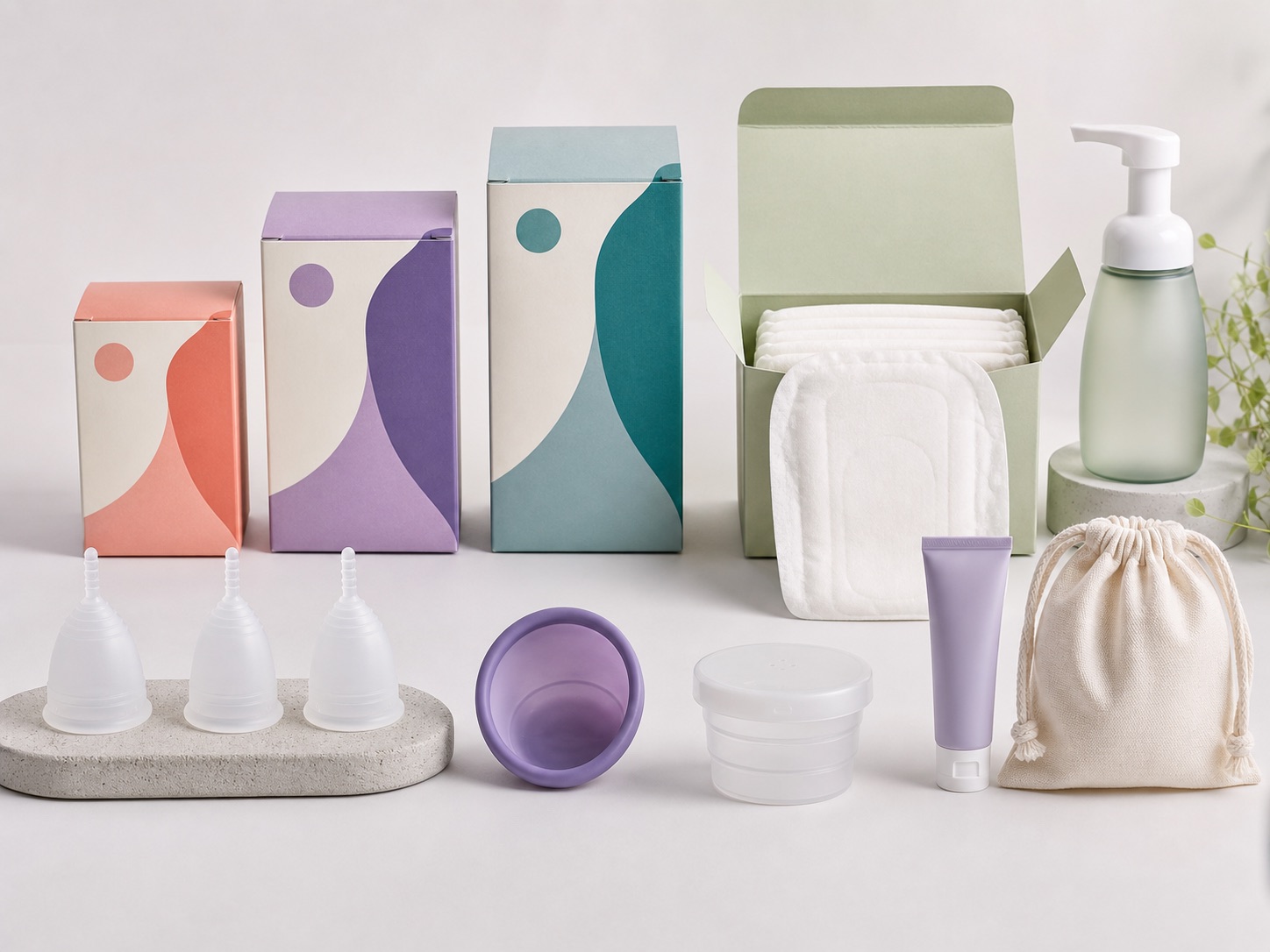
Buyer Summary
- Cups are usually the easier first reusable SKU for DTC, Amazon, pharmacy pilots, and starter-kit programs.
- Discs can support premium, higher-capacity positioning, but they require more insertion and removal education, stronger claim discipline, and more packaging support.
- The hero SKU decision should come before detailed RFQ work: mainstream reusable cup or premium-capacity disc.
- Industry-typical reusable OEM MOQs often start around 500 units per SKU, but YUJI’s actual MOQ must be confirmed in a written per-SKU quote after structure, color, packaging, tooling, and customization are defined.
- Final market approval, registration, and label claims remain the buyer’s responsibility.
Buyers often ask for both cup and disc quotes before they decide. That is understandable: the two formats sit inside the same reusable category, but they do not carry the same launch burden. This page compares capacity, education load, packaging, MOQ logic, documentation, and channel fit so the RFQ can start with a clear product choice.
Cups are easier to launch; discs suit premium positioning with more education. Start with the hero SKU decision: mainstream reusable cup or higher-capacity premium disc. Confirm MOQ logic, packaging readiness, and document needs before dual-SKU planning. A cup-first launch is often simpler, but a disc-led launch can work when the brand is ready to educate users and support premium claims.
Cup vs disc OEM: the practical difference
Menstrual cups are the mainstream reusable silicone starter SKU for DTC, Amazon, pharmacy pilots, and kit programs. They are familiar to many buyers and users, and they usually require moderate education around sizing, insertion, and care. That does not mean cups are “simple” in an OEM sense. They still need clear dimensions, capacity validation, material records, packaging artwork, and QC checkpoints.
Menstrual discs can support higher-capacity and premium positioning, but they usually need clearer insertion and removal education, stronger claim discipline, and more packaging support. Discs may also involve rim structure, return-feature design, and fit questions that are less familiar to first-time buyers. For that reason, a disc OEM program can be a strong premium play, but it is usually not the lowest-risk first reusable SKU unless the brand has an education plan.
Start with the hero SKU decision
The first decision is not “cup or disc?” in the abstract. It is “which product will be the hero SKU for this launch?” The hero SKU is the product that carries the launch story, packaging, sampling budget, and channel plan. If the hero SKU is unclear, cup and disc quotes may look comparable on paper but fail to answer the real business question.
If the brand needs a mainstream reusable entry product, start with cups. If the brand wants premium capacity positioning and can educate users, review discs. Some brands eventually launch both, but dual-SKU programs should follow a clear hero decision, not replace it.
Mainstream reusable: cup
A cup program usually fits brands that want a recognizable reusable format with broad channel potential. The buyer can focus on size range, silicone hardness, color, logo, pouch, box, leaflet, and kit configuration. The launch risk is lower for a first reusable SKU because the format is more familiar.
Higher-capacity premium: disc
A disc program fits brands that want to differentiate through capacity, comfort positioning, rim design, or premium kit presentation. The trade-off is education. Insertion, removal, and claim wording need more care. Packaging must often do more work, and the buyer should be ready to review instruction design and market claim language before artwork lock.
Cup OEM programs: the mainstream reusable starter
Cup capacity
Confirm quoted dimensions and verified capacity data for each proposed SKU. Capacity is not just a catalog number; it depends on the cup body, rim, fill line, and test method. Buyers should ask how capacity was measured and whether the quoted figure matches the intended market claim.
Cup capacity discussions should also connect to sizing. A cup range may include multiple sizes, and each size can have different capacity. If the launch plan includes more than one size, request a capacity reference for each proposed SKU, not a generic figure for the category.
Cup MOQ and customization
Cup MOQ should be confirmed in a written per-SKU quote after color, packaging, tooling, and customization are defined. Industry-typical catalog OEM cups and discs often start around 500 units per SKU. Custom printed cartons or pouches often start at 500+ units per design. New custom molds are usually discussed at 500+ units to amortize tooling. These are industry benchmarks, not YUJI commitments. YUJI’s actual MOQ must be confirmed per project.
Cup customization focus usually includes size, hardness, color, logo, pouch, box, and leaflet. Document focus usually includes material, biocompatibility-oriented records, EO plan, and QC release. Buyers should request the specific files available for the quoted SKU and manufacturing plan.
Disc OEM programs: premium capacity with education load
Disc capacity
Confirm quoted capacity, rim structure, and return-feature requirements. Disc capacity can be affected by rim design, basin shape, placement, and how the user wears it. A higher-capacity claim may sound attractive, but it must be supported by clear dimensions, test references, and user instructions.
Disc capacity also needs to align with the target market. Some channels expect detailed education; others expect simple packaging and a short instruction leaflet. The buyer should decide early how much education the package can carry and how much must live in digital content.
Disc MOQ and customization
Disc MOQ should be confirmed in a written per-SKU quote after structure, color, and pack plan are defined. As with cups, industry-typical reusable OEM MOQ often starts around 500 units per SKU. Rim or pull-ring tooling, custom packaging, and color matching can change the production plan. Buyers should not compare a cup quote and a disc quote unless both quotes define the same level of customization.
Disc customization focus usually includes rim feel, pull-ring design, color, and kit packaging. Document focus usually includes material, dimensional checks, packaging fit, and market claim review. Because discs are more education-dependent, packaging and leaflet review should happen earlier.
Side-by-side OEM comparison
| Decision point | Menstrual cups | Menstrual discs |
|---|---|---|
| Best channel fit | DTC, Amazon, retail starter kits, pharmacy pilots | Premium reusable launches and education-led markets |
| User education load | Moderate; sizing and insertion guidance still matter | Higher; insertion, removal, and claim wording need more care |
| Customization focus | Size, hardness, color, logo, pouch, box, leaflet | Rim feel, pull-ring design, color, kit packaging |
| MOQ logic | Confirm in a written per-SKU quote after color, packaging, tooling, and customization are defined. Industry-typical reusable OEM MOQ often starts around 500 units per SKU. | Confirm in a written per-SKU quote after structure, color, and pack plan are defined. New rim or pull-ring tooling and custom packaging can change MOQ. Industry-typical reusable OEM MOQ often starts around 500 units per SKU. |
| Document focus | Material, biocompatibility-oriented records, EO plan, QC release | Material, dimensional checks, packaging fit, market claim review |
| Launch risk | Lower for first reusable SKU | Higher if packaging and education are incomplete |
How to choose before requesting samples
1. Define the hero SKU
Write down whether the launch is cup-led or disc-led. If the brand needs a mainstream reusable entry product, start with cups. If the brand wants premium capacity positioning and can educate users, review discs. Do not let dual-SKU curiosity delay the hero decision.
2. Check packaging readiness
Cups often launch with pouch, box, and leaflet kits. Discs usually need clearer instruction design and claim review. Ask whether the current packaging concept can carry the required education without overcrowding the front panel. If not, adjust the pack plan before sampling.
3. Confirm MOQ logic
Ask for written cup and disc MOQ separately. Both can change with structure, color, packaging, tooling, and customization. Industry-typical MOQ may start around 500 units per SKU, but that figure is only a benchmark. YUJI must confirm the actual MOQ for the exact SKU and customization level.
4. Align documents early
Request material specs, available certificate scans, QC checkpoints, and packaging review files before artwork lock. For discs, include dimensional checks and claim review in the document plan. For cups, include sizing, capacity, and care instructions.
5. Decide whether to dual-SKU
Some buyers launch cups first, then add discs after the reusable category is established. Others launch a disc as a premium hero and add cups later as a volume SKU. Either path can work, but dual-SKU planning should not begin until the first product’s MOQ, packaging, and documents are understood.
Hero-SKU decision checklist
| Decision question | Choose cup if… | Choose disc if… | Evidence to request |
|---|---|---|---|
| Primary channel | DTC, Amazon, pharmacy, starter kits | Premium, education-led, differentiated reusable | Channel plan and competitor shelf review |
| Education capacity | You can explain sizing and insertion clearly | You can invest in insertion, removal, and claim education | Draft leaflet, digital content plan, claim list |
| Capacity positioning | Mainstream reusable capacity is enough | Higher-capacity premium positioning is central | Capacity data, dimensions, test method |
| Packaging readiness | Pouch, box, and leaflet can carry the story | Kit packaging and instruction design are ready | Artwork, pack plan, instruction draft |
| MOQ tolerance | You want a lower-risk first reusable SKU | You accept more customization and education load | Written per-SKU MOQ quote |
| Document readiness | Material and QC records can be reviewed early | Dimensional and claim review can be reviewed early | Document checklist and sample approval plan |
| Launch risk | Lower risk is the priority | Premium differentiation is worth the extra work | Risk register and market-entry plan |
| Dual-SKU plan | Cups first, discs later | Discs first, cups later as volume | Phased launch roadmap |
RFQ fields that make cup vs disc quotes comparable
Send target market, channel, preferred product format, capacity expectation, color, packaging language, sample quantity, first-order forecast, and document list. Without these fields, cup and disc quotes cannot be compared fairly.
Comparable-RFQ field table
| RFQ field | Why it matters for cup quotes | Why it matters for disc quotes | What to send |
|---|---|---|---|
| Target market | Determines labeling, language, and claim review | Determines education depth and claim sensitivity | Country/region and channel |
| Channel | Affects pack format and kit strategy | Affects instruction design and premium presentation | DTC, Amazon, pharmacy, distributor, retail |
| Product format | Confirms cup vs disc hero SKU | Confirms disc structure and rim direction | Cup or disc, with preferred style |
| Capacity expectation | Sets sizing and capacity reference needs | Sets rim, basin, and return-feature discussion | Target capacity range and use case |
| Structure and size | Affects mold, hardness, and dimensions | Affects rim feel, pull-ring, and fit | Size range, hardness, rim preference |
| Color and logo | Affects tooling, printing, and MOQ | Affects color matching and kit branding | Pantone references, logo files |
| Packaging language | Affects leaflet, box, and pouch artwork | Affects instruction clarity and claim review | English, multilingual, or market-specific |
| Sample quantity | Confirms sampling plan and approval steps | Confirms prototype and fit evaluation | Number of samples per SKU |
| First-order forecast | Helps define MOQ and production plan | Helps define tooling and pack plan | Estimated units per SKU |
| Document list | Confirms material, QC, and certificate needs | Confirms dimensional and claim review needs | Required files and approval deadlines |
| Tooling/customization | Changes MOQ and lead time | Changes MOQ and sample timeline | New mold, custom print, custom kit |
Timeline and sample planning
The timeline below uses industry-typical benchmarks. These are not YUJI commitments. YUJI must confirm timing per project, per SKU, and per customization level.
| Stage | Industry-typical timing | What locks the schedule | YUJI confirmation |
|---|---|---|---|
| Catalog samples | 7–14 days | Sample request and catalog selection | Confirm per project |
| Paid samples | 7–15 business days | Payment, sample spec, and shipping details | Confirm per project |
| Prototype-mold samples | 15–25 days | Tooling design and prototype approval | Confirm per project |
| Bulk production, catalog OEM | 25–40 calendar days | Packaging approval and deposit | Confirm per project |
| Bulk production, approved tooling | 30–45 days ex-works | Tooling approval, deposit, and production slot | Confirm per project |
| Sanitary-pad mass production | 35–40 days | Order confirmation and packaging approval | Confirm per project |
| Tampon MOQ benchmark | 100,000 pcs per SKU | Product spec and packaging plan | Confirm per project |
| Pad/liner MOQ benchmark | 300,000 pcs per SKU | Product spec and packaging plan | Confirm per project |
Per-market launch notes and checklist
| Market/channel | Education load | Packaging/claim priority | Document focus | Launch note |
|---|---|---|---|---|
| DTC | Moderate to high | Brand story, care instructions, clear FAQ | Material, QC, claim review | Digital education can carry more detail than pack |
| Amazon | Moderate | Main image clarity, A+ content, instruction leaflet | Material, dimensions, QC release | Avoid unsupported comparative claims |
| Pharmacy pilot | Moderate | Trust cues, simple instructions, compliance review | Material, biocompatibility-oriented records, QC | Buyer must confirm local registration requirements |
| Retail starter kit | Moderate | Kit presentation, pouch, leaflet, box | Packaging fit, sampling approval, QC | Kit complexity can change MOQ and timeline |
| Distributor/wholesale | Lower to moderate | Multilingual packaging, master carton, stable specs | Material specs, certificate scans, QC checkpoints | Confirm pack language and carton requirements early |
| Premium education-led | High | Instruction design, premium unboxing, claim discipline | Dimensional checks, claim review, packaging fit | Disc programs often need the strongest education plan |
Compliance boundary and document planning
Industry-typical certifications and tests buyers commonly ask about include ISO 13485, ISO 9001, ISO 10993 biocompatibility, CE technical-file support for Class I menstrual devices, FDA establishment registration — registration, not 510(k) clearance — SGS per-lot test reports, and REACH/RoHS. These are industry references, not claims about YUJI. YUJI does not claim to hold any certification unless it is confirmed in writing for the exact project. Document availability must be confirmed per project, per SKU, and per manufacturing plan.
Final market approval, registration, labeling, and market claims are the buyer’s responsibility. Buyers should review local requirements with their own regulatory counsel or agent. The OEM can support with requested documents where available, but the buyer owns the final market decision.
Frequently Asked Questions
Which is easier for a first private-label launch: a menstrual cup or disc?
Menstrual cups are usually easier for a first reusable launch because buyers and users recognize the format. Discs can support premium positioning but need more insertion, removal, and packaging education.
Does a menstrual cup or disc have a lower OEM MOQ?
Confirm MOQ separately for cup and disc programs in a written per-SKU quote. Product structure, color, pull-ring design, packaging, tooling, and customization can change the production plan. Industry-typical reusable OEM MOQ often starts around 500 units per SKU, but YUJI’s actual MOQ must be confirmed per project.
What MOQ should buyers expect for reusable OEM?
Industry-typical catalog OEM cups and discs often start around 500 units per SKU. Custom printed cartons or pouches often start at 500+ units per design. New custom molds are usually discussed at 500+ units to amortize tooling. Treat these as benchmarks only.
Which documents should buyers compare for cup and disc OEM programs?
Compare material specifications, dimensions and capacity, available certificate or test scans, packaging requirements, sample approvals, and QC release checkpoints for the quoted product. If certifications such as ISO 13485, ISO 9001, ISO 10993 biocompatibility, CE technical-file support, FDA establishment registration, SGS per-lot test reports, or REACH/RoHS are requested, confirm availability per project.
How long do samples usually take?
Industry-typical catalog samples usually take 7–14 days. Paid samples often take 7–15 business days. Prototype-mold samples often take 15–25 days. YUJI must confirm timing per project.
How long does bulk production usually take?
Industry-typical catalog OEM bulk production often takes 25–40 calendar days after packaging approval and deposit. Approved tooling may take 30–45 days ex-works. Sanitary-pad mass production may take 35–40 days from order confirmation. Confirm per project.
Can a brand launch cups first and add discs later?
Yes. Some buyers launch cups first, then add discs after the reusable category is established. Others launch a disc as a premium hero and add cups later. The important point is to define the hero SKU before dual-SKU planning.
What RFQ information prevents misleading quotes?
Send target market, channel, preferred product format, capacity expectation, color, packaging language, sample quantity, first-order forecast, and document list. Also define structure, rim or pull-ring preference, hardness, kit packaging, and customization level. Without these fields, cup and disc quotes cannot be compared fairly.
Move from comparison to specs, MOQ, and documents
Use this comparison to decide whether the launch needs a mainstream reusable cup or a premium, education-led disc. Then move quickly into written per-SKU MOQ, packaging readiness, sample approval, and document review. Contact YUJI’s OEM team with your target market, channel, hero-SKU preference, capacity expectation, packaging plan, and document list so the cup and disc quotes can be built on the same assumptions. Final market approval, registration, and label claims remain the buyer’s responsibility.