
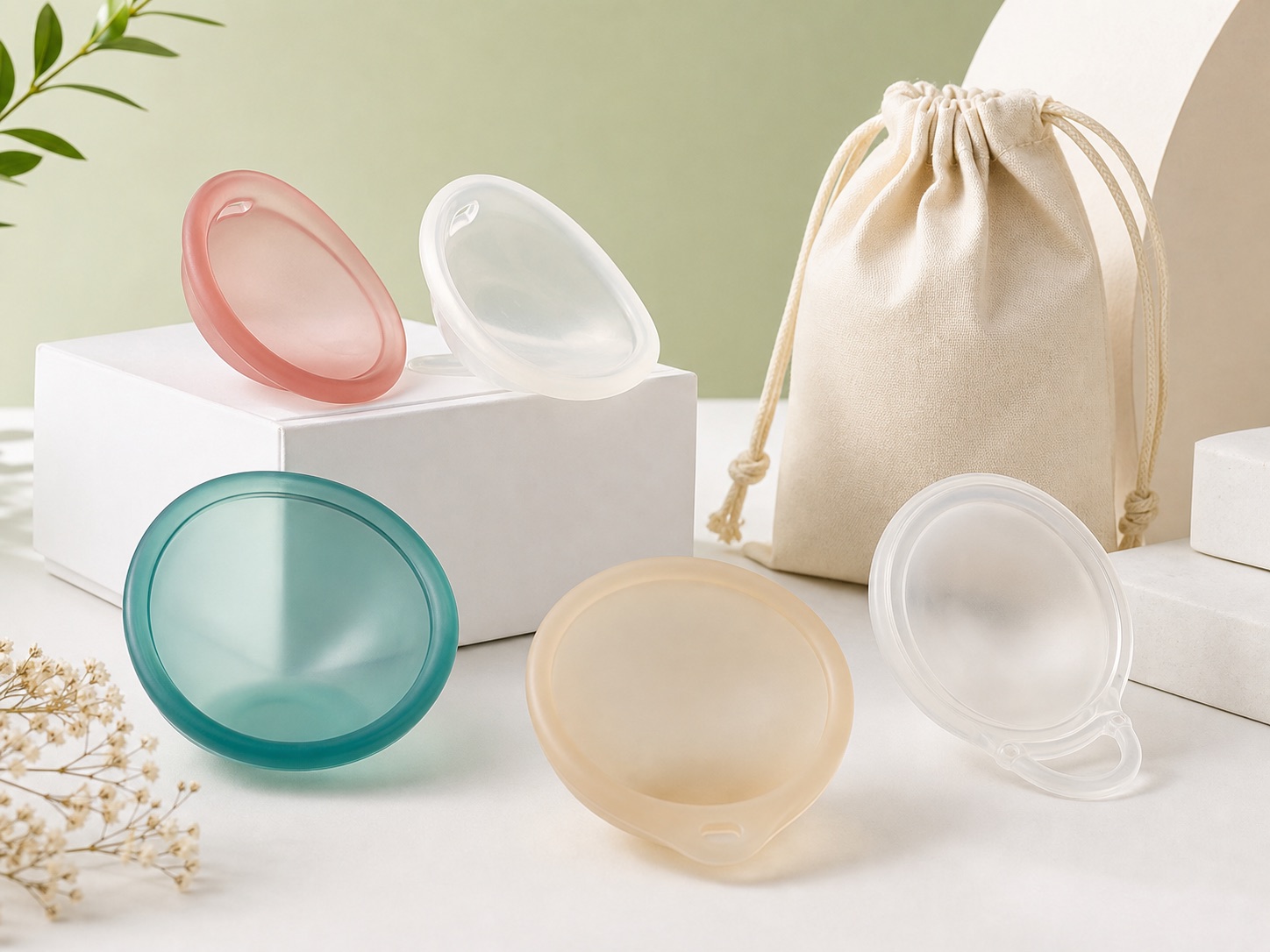
Buyer Summary
- Menstrual disc OEM MOQ is project-reviewed, not a single fixed number. Disc structure, color, packaging direction, sample approval path, document expectations, and launch forecast all move the quantity answer.
- Industry-typical catalog cup/disc OEM MOQ often starts around 500 units per SKU. Custom printed cartons or pouches often start at 500+ units per design. New custom tooling is usually discussed separately, often from 500+ units to amortize tooling.
- Sampling: catalog samples usually take 7–14 days; paid samples often 7–15 business days; prototype-mold samples often take 15–25 days.
- Bulk production: catalog OEM bulk typically runs 25–40 calendar days after packaging approval and deposit; approved tooling programs often run 30–45 days ex-works.
- Certifications are market-specific. Industry-typical certifications buyers ask about include ISO 13485, ISO 9001, ISO 10993, CE technical-file support for Class I menstrual devices, FDA establishment registration, SGS per-lot test reports, REACH, and RoHS. YUJI’s document availability must be confirmed per project. Final market approval, registration, and label claims remain the buyer’s responsibility.
Disc MOQ is project-reviewed, not a fixed number
MOQ is not a single number. For reusable menstrual discs, it depends on structure, color, packaging, sample approval, document expectations, and how much launch risk the buyer wants to remove before mass production. A buyer who asks only “What is your disc MOQ?” will usually receive either a generic range or a conditional answer that cannot be compared fairly against another supplier.
A useful disc MOQ quote should connect quantity to a defined project. That means the buyer should clarify whether the project is a fast private-label launch from an existing structure, a market test with limited packaging changes, or a more customized disc program that may involve new tooling, custom color, retail packaging, or market-specific documentation. Each path changes not only the MOQ but also sampling time, artwork review, QC planning, and production scheduling.
The goal before quoting is not to force every detail into the first email. The goal is to give the supplier enough project context so the quantity answer is tied to a real manufacturing path rather than a vague estimate.
The most useful MOQ answer starts with the launch model
Buyers often ask for menstrual disc MOQ before they have fixed the disc format, packaging, market language, or document needs. That makes quotes hard to compare. One supplier may quote a low number for a basic pouch-and-leaflet program, while another may quote a higher number because it assumes retail box packaging, custom color, and multi-language inserts.
A serious RFQ should state whether the buyer wants:
- a fast private-label launch from an existing structure,
- a market test with limited packaging changes,
- or a more customized disc program with new tooling, custom color, or retail-ready packaging.
This launch model is the first MOQ driver. It tells the supplier whether to review available disc options, adapt existing packaging, or plan development work. Without it, the supplier can only return a generic range.
Structure
Existing disc options usually quote faster than new tooling or shape development. Standard rim and pull-ring options can be reviewed from available programs. If the buyer wants a different rim firmness, diameter, removal feature, or anti-slip texture, the supplier may need to review tooling, sample rounds, and structural validation. In the broader industry, new custom molds are often discussed at 500+ units to amortize tooling, but the actual threshold depends on mold complexity and the supplier’s available programs. Buyers should confirm whether the quoted MOQ includes tooling amortization or treats it separately.
Color
Custom colors can change material planning, approval steps, and quantity logic. A catalog color may be available from existing silicone stock or a planned production run. A custom color may require a minimum batch of raw material, color matching, approval samples, and consistency checks across production lots. Buyers should confirm the quoted silicone grade, supplier specification, applicable test scope, color approval method, and consistency checks before production. If the color is tied to brand identity or retail packaging, the buyer should also plan for artwork and label approval before mass production.
Packaging
Box, pouch, leaflet, barcode, carton, and language choices affect MOQ. A simple pouch and leaflet is different from a retail box, multi-language insert, bundle kit, or distributor carton program. Industry-typical custom printed cartons or pouches often start at 500+ units per design, but the exact quantity depends on print method, material, size, and supplier scheduling. Packaging is often the hidden MOQ driver because the disc itself may be available at one quantity while the printed components require another. Buyers should define whether they need retail-ready packaging, e-commerce packaging, pharmacy packaging, or bulk distributor cartons.
Documents
Market-specific records and claim review should be requested before launch. Buyers should not wait until after packaging artwork is approved to ask whether the supplier can provide certain documents. Industry-typical certifications and test reports buyers ask about include ISO 13485, ISO 9001, ISO 10993, CE technical-file support for Class I menstrual devices, FDA establishment registration, SGS per-lot test reports, REACH, and RoHS. YUJI does not present this article as proof of any certification. Document availability must be confirmed per project and per market. Final market approval, registration, and label claims remain the buyer’s responsibility.
What changes menstrual disc MOQ?
Disc structure
Standard rim and pull-ring options can be reviewed from available programs. New development needs more planning. If the buyer wants a new shape, different rim firmness, or a new removal feature, the supplier may need to review tooling, prototype samples, and structural testing. This is usually a different MOQ path from a catalog disc.
Material and color
Confirm the quoted silicone grade, supplier specification, applicable test scope, color approval, and consistency checks before production. A custom color may require a minimum material batch, color-matching approval, and additional QC steps. The buyer should also confirm whether the color is cosmetic only or tied to a specific material supplier specification.
Packaging complexity
A simple pouch and leaflet is different from a retail box, multi-language insert, bundle kit, or distributor carton program. Retail packaging usually requires artwork approval, barcode verification, carton configuration, and sometimes market-specific label wording. Each printed component may carry its own MOQ.
Sample approval path
Buyers should confirm fit, rim feel, removal education, packaging copy, and artwork before placing a larger order. Sample approval is not just about whether the disc looks acceptable. It is also about whether the user instructions, insertion and removal education, and packaging claims are aligned with the target market. A poorly defined sample approval path can cause rework after the MOQ has already been quoted.
Compliance scope
The destination market may require additional document review, label wording checks, or importer-side validation. Buyers should list the documents they need before requesting the quote. If the market requires specific certificate scans or test reports, the supplier needs to know that early. Again, YUJI’s document availability must be confirmed per project, and the buyer remains responsible for final market approval and claims.
Launch forecast
A credible reorder plan often gives the supplier a better basis for production and packaging planning. A buyer who forecasts only the first order may receive a cautious MOQ. A buyer who shares a realistic reorder plan, channel plan, and seasonal forecast may give the supplier more confidence to review packaging and production in a more efficient way. This does not automatically lower MOQ, but it makes the discussion more practical.
MOQ-driver table
| MOQ driver | How it moves MOQ | What the buyer should define |
|---|---|---|
| Disc structure | Catalog rim/pull-ring options are easier to quote; new shape or tooling increases planning | Reusable disc format, rim feel, capacity expectation, pull-ring interest |
| Material and color | Custom color can require material batch planning, approval samples, and QC checks | Silicone grade, color reference, approval method, consistency expectation |
| Packaging | Printed boxes, pouches, leaflets, barcodes, and cartons can each have their own MOQ | Retail box or pouch, leaflet language, barcode, carton, bundle kit |
| Documents | Market-specific records and claim review should be scoped before launch | Target market, document list, label wording, importer requirements |
| Sample approval | More sample rounds can delay production and change quantity planning | Fit, rim feel, removal education, packaging copy, artwork approval |
| Launch forecast | A credible reorder plan helps production and packaging planning | First-order forecast, reorder plan, channel, launch date |
Disc MOQ comparison: catalog vs limited-custom vs new-tooling programs
The following comparison is a planning tool, not a YUJI quotation. Industry-typical values are shown only as benchmarks. Actual MOQ must be confirmed per project.
| Program type | Typical MOQ signal | What the buyer must define | Development risk | Best for |
|---|---|---|---|---|
| Catalog OEM disc | Industry-typical catalog cup/disc OEM MOQ often starts around 500 units per SKU | Existing rim/pull-ring format, available color, simple pouch/leaflet, target market | Lower | Fast private-label launch or first market test |
| Limited-custom disc | Custom printed cartons or pouches often start at 500+ units per design; custom color may add separate review | Disc format, custom color reference, packaging artwork, leaflet language, barcode | Medium | Retail pilot, DTC brand launch, limited packaging differentiation |
| New-tooling disc | New custom molds are often discussed at 500+ units to amortize tooling, but actual threshold depends on mold complexity | New shape, rim firmness, capacity, removal feature, sample rounds, structural validation, full packaging | Higher | Differentiated disc program with a committed launch forecast |
If a menstrual disc project is bundled with pads, liners, or tampons, buyers should plan those MOQs separately. Industry-typical pad/liner OEM MOQ can be much higher, such as 300,000 pcs per SKU, and tampons may be quoted around 100,000 pcs per SKU. These categories follow different production and packaging economics from reusable discs.
RFQ information that produces a real quote
Send the target country, channel, preferred disc format, capacity expectation, rim feel preference, pull-ring interest, color, packaging language, pouch or box structure, sample quantity, launch date, first-order forecast, and document list. Without these fields, the supplier can only return a generic range.
| RFQ field | Why it matters | Example buyer input |
|---|---|---|
| Target market | Controls label language and claim risk | US DTC, English packaging |
| Disc format | Affects sample and tooling path | Reusable disc with pull-ring option |
| Pack structure | Changes packaging MOQ and lead time | Retail box, pouch, leaflet, barcode |
| Document needs | Prevents late compliance surprises | Specs, available certificate scans, QC release |
| Channel | Changes education and packaging expectations | DTC, retail, pharmacy, distributor |
| Sample quantity | Helps supplier plan sample production | Fit sample set, color sample, packaging mockup |
| Launch date | Sets realistic sampling and production sequence | Target launch quarter, reorder plan |
| First-order forecast | Supports production and packaging planning | Initial MOQ, reorder window, seasonal plan |
Buyers should also state whether they need a quotation for a fully finished retail product, a bulk pack for repackaging, or a distributor carton program. Each path can change the MOQ, the artwork review, and the documentation scope.
Timeline: sampling → artwork → production → shipping
| Stage | Industry-typical range | Buyer action | Release condition |
|---|---|---|---|
| Catalog sampling | Usually 7–14 days | Review fit, rim feel, removal education, and basic packaging direction | Sample approval |
| Paid sampling | Often 7–15 business days | Confirm color, packaging direction, and any custom label needs | Paid sample approval |
| Prototype-mold sampling | Often 15–25 days | Review structure, user education, and fit before tooling commitment | Tooling/sample approval |
| Artwork and packaging approval | Time varies by complexity | Check barcode, language, leaflet, carton, and label claims | Artwork sign-off |
| Catalog OEM bulk production | Typically 25–40 calendar days after packaging approval and deposit | Confirm deposit, QC plan, and shipping terms | QC release |
| Approved tooling bulk production | Often 30–45 days ex-works | Confirm tooling sign-off, production schedule, and inspection plan | Inspection and release |
| Shipping handoff | Depends on Incoterm and destination | Coordinate freight, documents, and importer requirements | Export documents and delivery coordination |
These ranges are industry benchmarks, not promises. Actual timing depends on sample feedback, artwork readiness, material availability, packaging print queues, and the buyer’s document requirements.
Recommended path for a first disc launch
Start by comparing available disc structures, then request samples with packaging direction. After fit, rim feel, and user-education copy are reviewed, confirm artwork, document scope, and first-order forecast. This order of work reduces rework and makes MOQ negotiation more practical.
A practical sequence for a first disc launch is:
1. Define the target market and channel. 2. Select a catalog disc structure or define the custom structure clearly. 3. Confirm color direction and packaging format. 4. Request samples and review fit, rim feel, and removal education. 5. Draft packaging copy and label wording. 6. Confirm document needs before artwork is finalized. 7. Share the first-order forecast and reorder plan. 8. Request a project-specific MOQ quote with timeline.
This sequence helps the buyer avoid a common mistake: negotiating MOQ before the product, packaging, and document scope are defined. When those variables are fixed, the supplier can quote a more realistic quantity and schedule.
Per-market checklist
| Market / channel | Label and claim focus | Documents commonly requested by buyers | Buyer checkpoint |
|---|---|---|---|
| US DTC | English packaging, clear education, claim review | FDA establishment registration (registration, not 510(k) clearance), specs, QC release | Confirm supplier document availability and importer-side validation |
| EU / UK | Local language, CE-related technical file support, label wording | CE technical-file support for Class I menstrual devices, ISO 13485, ISO 10993, REACH | Confirm responsible person, importer, and final label claims |
| Retail / pharmacy | Barcode, carton, multi-language leaflet, retail-ready box | ISO 9001, SGS per-lot test reports, QC release, artwork approval | Confirm barcode, carton configuration, and shelf-ready packaging |
| Distributor / bulk | Distributor carton, bundle kit, repackaging instructions | Specs, available certificate scans, QC release, batch records if available | Confirm reorder plan, carton marking, and delivery terms |
Buyers should treat this table as a planning checklist, not legal advice. Market requirements change, and final approval, registration, and label claims are the buyer’s responsibility.
Compliance boundary and certificate wording
YUJI does not claim to hold any certification for a buyer’s specific project unless that is confirmed in writing for that project. Certifications and test reports are market-specific and project-specific. Industry-typical certifications buyers ask about include ISO 13485, ISO 9001, ISO 10993, CE technical-file support for Class I menstrual devices, FDA establishment registration, SGS per-lot test reports, REACH, and RoHS.
When a buyer asks about certificates, the useful question is not only “Do you have it?” but “Can you provide the applicable document for this product, this material, this market, and this production lot?” YUJI’s document availability must be confirmed per project. The buyer should also confirm whether the document is a certificate, a test report, a declaration, or a technical-file support document. Final market approval, registration, and label claims remain the buyer’s responsibility.
Frequently Asked Questions
Is menstrual disc OEM MOQ a fixed number?
No. Disc MOQ is project-reviewed. It depends on disc structure, color, packaging, sample approval, document expectations, and launch forecast. A catalog program and a new-tooling program will not have the same MOQ logic.
What is an industry-typical MOQ for catalog menstrual discs?
Industry-typical catalog cup/disc OEM MOQ often starts around 500 units per SKU. This is only a benchmark. The actual quote depends on the selected structure, color, packaging, and supplier schedule.
Does custom color change menstrual disc MOQ?
It can. Custom color may require material batch planning, color matching, approval samples, and consistency checks. The exact quantity impact depends on the supplier’s material planning and the chosen color reference.
Does custom packaging increase MOQ?
Yes, it often does. Custom printed cartons or pouches often start at 500+ units per design. Multi-language leaflets, retail boxes, bundle kits, and distributor cartons can each add their own minimum quantity.
What sampling lead time should buyers plan for?
Industry-typical catalog samples usually take 7–14 days. Paid samples often take 7–15 business days. Prototype-mold samples often take 15–25 days. Buyers should confirm the schedule after defining the disc format and packaging direction.
How long does bulk production take?
Catalog OEM bulk production typically runs 25–40 calendar days after packaging approval and deposit. Approved tooling programs often run 30–45 days ex-works. Actual timing depends on material availability, artwork readiness, and QC release.
What certifications do buyers commonly ask about?
Common industry-typical requests include ISO 13485, ISO 9001, ISO 10993, CE technical-file support for Class I menstrual devices, FDA establishment registration, SGS per-lot test reports, REACH, and RoHS. YUJI’s document availability must be confirmed per project.
Who is responsible for market approval and label claims?
The buyer is responsible for final market approval, registration, and label claims. The supplier can provide available product specifications, QC release documents, and applicable certificate scans if available, but the buyer must validate the requirements for the destination market.
Send your disc RFQ with the right details
To get a useful menstrual disc OEM MOQ quote, send the target market, channel, disc format, capacity expectation, rim feel, pull-ring interest, color, packaging language, pouch or box structure, sample quantity, launch date, first-order forecast, and document list. A project-specific RFQ reduces back-and-forth and makes MOQ comparison more meaningful.
- Menstrual disc OEM — Review disc formats, rim options, packaging paths, and buyer-fit guidance.
- OEM workflow — Understand sample approval, artwork review, QC release, and export handoff.
- RFQ checklist — Prepare market, quantity, packaging, and document requirements before quote comparison.
- Channel applications — Compare education, packaging, and document needs across DTC, retail, pharmacy, and distributor programs.
- Buyer resources — Browse all MOQ, RFQ, and sourcing guides for your procurement workflow.